Rocketspin KYC and Verification: Documents, Holds and Withdrawal Checks
 Available in US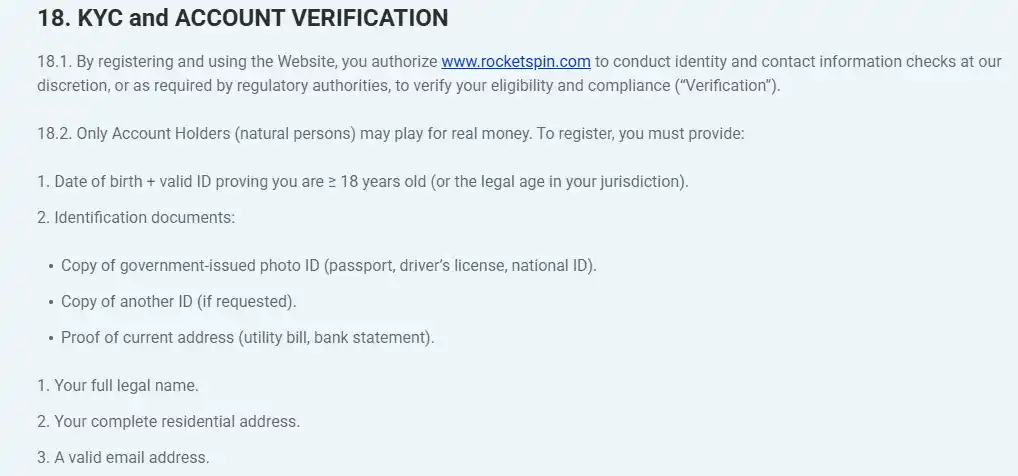
Rocketspin’s current Terms allow identity and contact checks and say withdrawals can remain pending until required verification is complete. The Terms currently name three core evidence categories that can be requested: government-issued photo ID, proof of current address and evidence of the payment method. They also allow additional documents or other verification steps, so the list is not exhaustive.
No fixed Rocketspin KYC completion time is verified in the current official Terms. This page therefore does not publish a 24-hour, 48-hour or similar verification promise. It separates the document-review stage from withdrawal approval and payment delivery. The exact request is account-dependent, and completing KYC does not by itself guarantee a particular withdrawal outcome or arrival time.
Table of Contents
- What Rocketspin’s current Terms verify about KYC
- Identity evidence
- Proof of address
- Payment-method evidence
- Additional checks can include contact verification
- Why withdrawals can remain pending during verification
- No fixed KYC completion SLA is verified
- Verification triggers and account context
- Document categories versus exact case requirements
- How to read a verification request critically
- Australian regulatory context is a separate question
- Sources and date checked
- Summary
- Recommend
What Rocketspin’s current Terms verify about KYC
The official Terms were rechecked on 10 September 2026 because exact KYC requirements are a residual high-risk fact. The account section says Rocketspin can request additional documentation or conduct a phone call to verify identity. It also says withdrawal requests remain pending until the required verification steps are complete.
A later anti-fraud section identifies government-issued photo ID, proof of address and proof of payment method as document categories that can be requested. The Terms also say further verification can be required. In the dedicated KYC and Account Verification section, Rocketspin again lists government-issued photo ID and proof of current address and says it can request additional information or documentation, including proof of payment method.
Because the same official source allows additional checks, a review should not present any three-item list as a complete or universal checklist for every account. The correct framing is “documents that may be requested under the current Terms”, not “everything every player must submit”.
Identity evidence
Rocketspin’s Terms name government-issued photo identification. Examples in the current wording include a passport, driver’s licence and national ID in the KYC section, while another clause gives passport and driver’s licence examples. The evidence purpose is identity and age rather than simply possession of any photo document.
The Terms also allow another ID to be requested. This matters because it prevents a fixed statement such as “one passport is always enough”. A document can be rejected or followed by another request if the operator considers the identity information incomplete or inconsistent.
The supported conclusion is that a government-issued photo ID is a named core category and that additional identity evidence can be requested. This page does not prescribe which exact document a particular reader should upload because the current Terms leave room for account-specific checks.
Proof of address
The current Terms also identify proof of current address. Examples include a utility bill or bank statement. The KYC section links that evidence to the residential address supplied for the account, while the anti-fraud section uses the same general category when describing identity confirmation.
A useful distinction is between the category and the acceptance rules. The category is verified: proof of address can be requested. The current Terms do not provide a universal page-level specification here for document age, file size, upload format or every accepted issuer. Those details should not be invented from general casino KYC practice.
If an account is asked for address evidence, the operator’s live request should be treated as the current instruction for that case. This guide records the document category but does not substitute a generic checklist for a case-specific request.
Payment-method evidence
Payment ownership can be part of the verification process. The Terms name proof of payment method and give examples such as a credit-card front/back image or an image of an e-wallet account page in one KYC clause. They separately require deposits to come from a payment account registered in the account holder’s own name.
That creates a direct connection between account identity and cashier activity. The verification question is not just “who is the person?” but can also include “does the payment method belong to that person?” The dedicated payment methods covers the current AU cashier options; this page only addresses payment evidence as a KYC category.
Security handling still matters. A request for payment evidence does not justify publishing full card details, balances or unrelated financial information. This article does not invent a masking standard because the current Terms do not provide a universal redaction specification on this page. Users should follow the current operator request and their payment provider’s security guidance.
Additional checks can include contact verification
Rocketspin’s current Terms allow a phone call as part of KYC and refer to identity and contact-information checks. They also contain consequences if the operator cannot reach an account holder by phone or email within the stated contact window attached to a withdrawal or verification request.
This is an important information-gain point because KYC is not purely a document upload exercise in the current Terms. A case can include contact verification in addition to images or statements. An article that lists only ID and proof of address would therefore omit part of the operator’s published verification framework.
At the same time, the existence of a phone-verification clause does not mean every account will receive a phone call. The Terms give the operator discretion to request it. The correct statement is that contact verification can form part of the process.
Why withdrawals can remain pending during verification
The current Terms directly connect KYC to withdrawals. They say withdrawal requests remain pending until all required verification steps are completed, and another refund/KYC clause says withdrawals and refunds remain on hold until the account is fully verified. A separate withdrawal clause gives the operator the right to verify identity before processing a payout.
This is why a payment-method speed should never be used as a KYC promise. The AU withdrawal table currently displays Visa and Mastercard at 1-3 banking days and lists several crypto methods and CashToCode with an “Instant” label. Those are method-level processing labels. An account can still be awaiting verification before the payout reaches the method stage.
For the full timing model, use the withdrawal timing. It separates cashier labels, operator approval, verification and external delivery instead of compressing them into one number.
No fixed KYC completion SLA is verified
The current official Terms do not publish a fixed KYC completion time such as 24 hours or 48 hours. They contain several time references for other processes, including contact windows and withdrawal processing after approval, but those are not a universal document-review SLA.
This distinction is easy to lose in casino reviews. A 72-hour withdrawal processing target after approval does not mean KYC itself will be completed within 72 hours. Likewise, a 1-3 banking day card label does not describe how long identity documents will take to review. Each number belongs to a different stage.
Because the current official Terms do not state a fixed KYC SLA, no precise verification time should be presented as a confirmed Rocketspin standard. If Rocketspin later publishes a clear KYC processing standard, it should be rechecked and added as a new high-risk fact rather than inferred from payment timings.
Verification triggers and account context
The Terms allow verification at the operator’s discretion or where required by regulatory authorities. They also connect checks to age, eligibility, withdrawals, anti-fraud review and payment ownership. This means KYC should be understood as an account-control process that can appear at more than one point.
The broader account rules covers the one-account rule, personal-use expectations, support channels and safer-gambling controls. This child page stays narrower: what evidence the Terms name, what can be held while checks are incomplete, and which timing claims are not supported.
That boundary avoids a common thin-content problem. Registration steps, customer support and responsible-gambling tools are not repeated here unless they directly explain a verification outcome.
Document categories versus exact case requirements
| Category | Examples in current Terms | What can safely be concluded |
|---|---|---|
| Identity | Passport, driver’s licence, national ID | Government-issued photo ID is a named category; additional ID can be requested |
| Address | Utility bill, bank statement | Proof of current address is a named category |
| Payment method | Card evidence, e-wallet account image | Payment-method ownership can be checked |
| Contact or enhanced verification | Phone call, additional information or documents | The process is not limited to the three document categories |
This table is intentionally not presented as a guaranteed upload checklist. Exact requests can change with the account and with the operator’s current verification process.
How to read a verification request critically
- Separate the document category from the exact document requested for the account.
- Check whether the request is about identity, address, payment ownership or contact verification.
- Do not assume a cashier processing label is the same as KYC review time.
- Do not treat completion of document review as a guarantee that a withdrawal will arrive by a particular deadline.
- Use current official terms because document and verification clauses can change.
- Keep sensitive personal and payment data out of public images or review content.
These points are procedural reading guidance, not instructions for bypassing or manipulating verification.
Australian regulatory context is a separate question
KYC does not establish Australian local licensing. An operator can run identity checks under its own terms and offshore regulatory framework without that creating ACMA approval or Australian casino consumer-protection coverage. The regulatory context page addresses those issues separately.
This distinction also prevents a trust shortcut. Asking for documents can be a normal account-control function, but the existence of KYC should not be used as proof that a service has a particular local regulatory status. Identity verification and licensing are independent facts that require independent evidence.
Sources and date checked
The current Rocketspin Terms and Conditions were checked on 10 September 2026. The official source confirms the named document categories, contact-verification possibility and withdrawal holds described above. No fixed KYC completion SLA was found in the current Terms, so none is published here.
Summary
Rocketspin’s current Terms support four important conclusions. First, identity verification can be requested. Second, the published evidence categories include government-issued photo ID, proof of current address and payment-method evidence, with additional checks possible. Third, withdrawals can remain pending while required verification is incomplete. Fourth, no fixed KYC completion time is currently verified.
That evidence-led framing is more useful than a generic “KYC takes 24 hours” claim because it preserves the difference between document review, withdrawal approval and payment delivery. For the wider brand overview, return to the Rocketspin Australia guide.