Australian Online Pokies: Offers, Payments and Risks
 Available in AU

The guide separates local terminology from operator licensing and explains payment, bonus, verification and cash-out issues around offshore sites.
Table of Contents
- What “Australian Pokies” Means Online
- Real-Money Play and the Limits of Consumer Protection
- PayID, Bank Transfers and the Friction of Payment
- No-Deposit Offers and the Conditions Behind Them
- Sign-Up Bonuses: The Turnover Behind the Headline
- Free Play, Free Spins and the Cash-Out Catch
- Pokies on a Phone: Access Without an App Promise
- Online Pokies and Australia’s Gaming-Machine Culture
- Trust, Verification and Offshore-Site Uncertainty
- New Games, Old Randomness
- Pokies
What “Australian Pokies” Means Online
“Australian pokies” describes a market from the player’s side of the screen, not a category of casino licensed in Australia. The phrase can refer to online pokies offered to people in Australia, even when the company operating the site is based elsewhere. That distinction matters: a familiar local term does not make the service Australian, and access from an Australian address does not make it locally regulated.
The legal line is drawn around the operator. Under the Interactive Gambling Act 2001, companies cannot provide real-money online pokies to people in Australia without a domestic licence. No Australian online-casino licences have been issued. There is therefore no Australian-licensed online casino behind the offers described as Australian online pokies.
That leaves a conspicuous gap between what a site may appear to offer and what the domestic system authorises. An offshore operator may accept Australian customers, but that acceptance is not an Australian licence, nor does it turn the operator into a locally regulated business. The word “Australian” in a page title or menu can identify the intended audience; it cannot change the company’s legal status.
Choosing an online pokies site involves more than finding games: it is worth checking the available operator information before deciding where to play. This list offers a concise starting point for Australian players comparing the details provided for each option.
1. Rollero Casino
License: Curacao Gaming Control Board OGL/2023/176/0095 (Hollycorn N.V.) Rollero Casino is listed with a Curacao Gaming Control Board licence, OGL/2023/176/0095, held by Hollycorn N.V.
2. 7Bit Casino
License: Curacao, operated by Dama N.V. 7Bit Casino is operated by Dama N.V. and is listed as licensed in Curacao.
3. JustCasino
License: Curacao Gaming Control Board JustCasino is listed with a Curacao Gaming Control Board licence.
4. Bizzo Casino
License: Curacao Gaming Control Board (TechSolutions Group N.V.) Bizzo Casino is listed with a Curacao Gaming Control Board licence, with TechSolutions Group N.V. named in connection with it.
5. SkyCrown
License: Tobique Gaming Commission · Payout speed: crypto ~10-15 minutes, fiat 1-5 days · Min. deposit: A$30 SkyCrown is listed with a Tobique Gaming Commission licence and a minimum deposit of A$30. Its stated payout times are around 10–15 minutes for crypto and 1–5 days for fiat.
6. Uptown Pokies
License: Curacao (operating since 2017) · Min. deposit: A$20 Uptown Pokies is listed as operating since 2017 under a Curacao licence, with a minimum deposit of A$20.
7. DragonSlots Casino
License: Curacao Gaming Authority (Jumpman Gaming Ltd) DragonSlots Casino is listed with a Curacao Gaming Authority licence, with Jumpman Gaming Ltd named as the operator.
8. Kingmaker
Payout speed: crypto ~90 minutes, fiat 1-5 days · Min. deposit: A$30 Kingmaker lists a minimum deposit of A$30. Its stated payout times are around 90 minutes for crypto and 1–5 days for fiat.
9. House of Pokies
License: international iGaming licence – jurisdiction not named in the source · Payout speed: PayID 1-24 hours · Min. deposit: A$30 (PayID from A$10) House of Pokies lists an international iGaming licence, though the jurisdiction is not named. PayID payouts are stated as taking 1–24 hours, and the minimum deposit is A$30, or A$10 for PayID.
10. Wild Tokyo
License: Curacao · Payout speed: crypto 30-60 minutes, fiat 1-5 days · Min. deposit: A$10 Wild Tokyo is listed with a Curacao licence and a minimum deposit of A$10. Its stated payout times are 30–60 minutes for crypto and 1–5 days for fiat.
The law’s target is the business providing the prohibited service, rather than the individual who plays. That distinction is easy to blur in ordinary conversation, where “legal” can describe the whole transaction as though both sides stood in the same position. They do not. A player’s lack of liability under the Act does not make the offshore company’s offer lawful in Australia. Nor does it supply a domestic licence that does not exist.
This is why searches for the best Australian pokies online can lead to a confusing landscape. Sites may present themselves as available to Australians, while the legal framework does not recognise a local online-casino sector. The apparent market is made up of offshore services, not a row of Australian-licensed casinos competing under a domestic casino scheme. “Available” and “authorised” are different words. Here, the difference is the point.
The distinction also prevents a misleading comparison with familiar Australian businesses. A company operating a licensed venue in Australia is not thereby authorised to run an online casino for people in the country. Online real-money pokies fall under a separate prohibition. The setting may look similar—the same kind of spinning game, now displayed on a screen—but the legal category is not determined by the game’s appearance.
For that reason, “online Australian pokies” is best understood as shorthand for an audience and a location, not a promise about the operator’s origin or oversight. Some offshore sites may accept people in Australia; that fact describes their conduct, not a local endorsement. An Australian-facing website can use local currency or familiar language and still remain an offshore service. Appearance does little legal work.
Adelaide Casino Guide: Rooms, Dining and Practical Searches · Pokies in Sydney: Find a Venue and Check the Details
The result is an unusual arrangement: the player is not the party the law targets, while the service being offered remains prohibited when supplied to people in Australia without a domestic licence. There is no local online-casino licence to verify, because none has been issued. The phrase “best Australian pokies” can therefore suggest a settled domestic market that the law has not created. The market’s name is more settled than its legal footing.
That is the essential meaning of “Australian” in this context. It points to Australians being addressed by an online service, not to an Australian licence, regulator, or locally authorised casino. A national label can travel further than national law.
Real-Money Play and the Limits of Consumer Protection
Real-money play changes the stakes of an online pokie from entertainment on a screen to a claim on money held by an offshore business. That claim may look straightforward while a balance is growing. It becomes less abstract when a withdrawal is requested and the operator controls the account, the records and the process for releasing funds.
For people in Australia, the legal setting offers no domestic online-casino framework through which to pursue an unpaid offshore balance. If an offshore casino declines to release winnings, Australian players have no legal recourse in Australia against that refusal. The practical consequence is stark: a dispute about money may arise in a relationship where the player cannot call on an Australian casino regulator to order payment. The operator’s terms and internal complaint process may remain, but they are not a substitute for local legal protection.
Financial Risk
If an offshore casino refuses to release winnings, Australian players have no legal recourse in Australia to recover those funds.
This is not simply a matter of whether a site appears polished or whether an account shows a large figure. A displayed balance is not the same as money in a bank account. Withdrawal rules may specify verification steps, minimum amounts, processing procedures or caps on how much can leave an account over a period. The terms governing those rules matter most at the moment when the player is no longer depositing but asking for funds back.
Some specialist casino reviews report weekly or monthly withdrawal ceilings in the range of $5,000 to $10,000 at certain casinos. Under such a cap, a $50,000 jackpot could be paid in instalments over a period extending into years, rather than arriving as a single transfer. These figures are not a universal schedule; they illustrate how a payout limit can change the meaning of a win. A large balance may be technically withdrawable yet practically slow to recover. The arithmetic is simple. The waiting is not.
A cap also makes timing important. The rules may distinguish between the amount requested and the amount the operator will process within a given period. If a player has not checked the withdrawal terms before depositing, the limit may become visible only after a win, when the balance feels like something already owned. That feeling is understandable, but it does not alter the operator’s stated conditions or create an Australian route to enforce them.
Identity checks are another part of the withdrawal process. Specialist casino reviews describe operators requiring verification before the first cash-out, including a photograph of an identity document and proof of address; some may also ask for a selfie with the document. These requirements can delay access to funds if documents are missing, unclear or inconsistent with account details. Identity and address proof should therefore be treated as a condition of account use, not an administrative surprise after a win. The operator’s instructions should be read before money is placed at risk, and copies of submitted documents and relevant correspondence should be kept.
RTP Pokies in Australia: How to Compare Returns
Verification can serve a legitimate purpose, but its presence does not establish that an operator is locally regulated or that a disputed payout will be resolved fairly. Nor does completing a document check guarantee that a withdrawal will be approved. These are separate questions: who controls the account, what conditions apply, and what remedy exists if the operator does not follow its own process. In Australia, the gap is that the local legal system does not provide recourse against an offshore casino’s refusal to pay.
The wider law reflects that boundary. The Interactive Gambling Act 2001 prohibits companies from providing real-money online casino games, including pokies, to people in Australia. The prohibition is directed at operators, not at individual players; that distinction does not turn an offshore service into an Australian-regulated one or create local consumer protection for its customers. A person may encounter an offshore site, but access and legal remedy are different matters.
The more money involved, the less useful a general impression of a site becomes. A clear-looking cashier, a recorded balance or a completed verification screen cannot settle a dispute by itself. The decisive details sit in the withdrawal terms and in the jurisdiction governing the operator. Where an Australian remedy is absent, a player’s ability to recover withheld winnings may be severely limited. That is the central financial risk of real-money pokies offshore: the possibility of losing the stake is only one part of the exposure.
Withdrawal Readiness
- Read the operator’s withdrawal terms and conditions
- Check for any weekly or monthly withdrawal ceilings
- Prepare a photograph of an identity document
- Prepare a valid proof of residential address
- Verify the jurisdiction governing the operator
PayID, Bank Transfers and the Friction of Payment
PayID is not a separate bank account or a promise that a payment will go through. It is an alias layer on Australia’s New Payments Platform (NPP): a transfer can be addressed using an email address, mobile number or ABN instead of bank details. The alias points to a bank account, so setting up PayID for a transaction requires that link to exist first.
The NPP is supported by all major Australian banks and uses end-to-end encryption. Those features describe the payment infrastructure, not the legality of whatever a transfer might fund. The distinction matters in the context of online pokies. Under the Interactive Gambling Act 2001, it is illegal for an operator to provide real-money online casino games to people in Australia without a domestic licence, and no such licences have been issued. A familiar payment method cannot turn a prohibited service into a locally authorised one.
That is the first friction: the payment rail and the gambling service belong to different systems. PayID can identify where money is sent; it cannot establish whether an operator is licensed, whether its games use a particular return setting, or whether a transaction will be accepted by a bank. Payment convenience is not a regulatory seal.
Live casino online in Australia: legal limits · Most Trusted Online Casinos in Australia: Legal Reality
There is also a practical obstacle. Some Australian banks, including members of the Big Four, have occasionally blocked PayID transfers to merchants identified as gambling-related, according to a specialist review. That observation should be read as a report about payment friction, not as a permanent rule applying to every bank or transaction. Banks and payment providers can change how they classify or handle transfers; the presence of PayID on a payment page does not settle what will happen at the bank’s end.
A specialist review has likewise reported that Australian banks and card companies are increasingly blocking transactions to known gambling sites. In practice, a transfer may therefore fail even when the alias is entered correctly and PayID is available as a listed method. The disruption is not necessarily a defect in the alias system. It may reflect a bank’s decision about the recipient or transaction.
A card is not necessarily a simpler substitute. A specialist review notes that a credit or debit card gambling deposit may be treated by a bank or card issuer as a cash advance, potentially attracting a fee of 3–5% and immediate interest. Those charges depend on the issuer’s treatment of the transaction, rather than on the wording of a casino cashier. The apparent familiarity of a card payment can conceal a different cost structure.
PayPal searches often sit beside searches for PayID, but the two names do not establish interchangeable payment options. PayID’s mechanics are specific: an alias routes a transfer through the NPP to a linked bank account. A service displaying another payment logo would still need to be considered on its own terms. None of these payment arrangements answers the separate legal question about an operator serving people in Australia.
PayID is an alias layer on Australia’s New Payments Platform (NPP) that allows transfers using an email, mobile number, or ABN instead of bank details.
The phrase “Australian PayID pokies” can make the method sound like a local product category. It is not. PayID is an Australian payment mechanism; it does not make online pokies Australian-licensed. The law concerns the operator providing the real-money game, not the label attached to a transfer. Nor does a successful deposit show that the game’s settings are transparent. The same payment path could coexist with different information—or a lack of clear information—about a game.
That distinction is easy to lose in a checkout screen. A bank logo, a familiar alias, and a neatly designed cashier all speak the language of ordinary commerce. None alters the legal position. ACMA enforces the Interactive Gambling Act 2001, and the existence of a payment route should not be mistaken for approval from the regulator.
For anyone comparing payment descriptions, the useful question is not merely whether PayID appears on a page. It is what the alias does, which bank account it is linked to, and whether the bank permits the particular transfer. Those answers concern payment mechanics. They do not validate an offshore gambling service or certify its games.
A transfer can be technically straightforward and still run into institutional resistance. That is the small but telling gap between an efficient national payment network and a gambling transaction that banks may choose to block. The rail is not the licence.
No-Deposit Offers and the Conditions Behind Them
A “no-deposit” promotion describes an offer that does not require a standard deposit to begin. The label can sound like a clean break from the usual exchange of money for play. In practice, it names an entry condition, not the value or usability of any resulting winnings. The terms attached to an offer decide what happens after the initial play.
Fast payout online casinos in Australia: key checks
That distinction matters because the advertised free element may come with restrictions. A specialist review reports that free-spin promotions can place a ceiling on the winnings eligible for cash-out. A balance shown after play, then, does not necessarily represent an amount that can be withdrawn in full. The cap is a condition of the offer, not a detail to be inferred from its headline.
The mechanics can make a small promotion look more substantial than it is. A free spin may produce a win, but the promotional terms may limit how much of that win can be cashed out. The amount, if any, available to withdraw is therefore not settled by the spin alone. It depends on the stated conditions. A no-deposit offer is not the same thing as unrestricted cash.
The phrase “no deposit” can also obscure what comes next. Some promotions are limited to free play; others are presented alongside a request to make a deposit to access further features or benefits. Those are different arrangements. The first question is whether a deposit is required for the specific offer, rather than whether the promotion uses “free” prominently in its description. Bonus codes do not change that basic distinction: a code may identify or activate an offer, but it does not explain its cash-out conditions.
There is a revealing contrast between a free entry offer and the modest deposit thresholds described in specialist reviews. One such review reports minimum deposits of AU$10 to AU$20 at most operators it covers, with some accepting AU$5. These are reported figures, not a universal tariff or a stable promise across the market. Deposit conditions can differ by operator and offer; the amount attached to one promotion cannot be assumed to apply to another.
Do
- Read the full conditions of no-deposit offers
- Check for cash-out caps on free winnings
- Verify if further deposits are required for features
Don’t
- Assume “free” means unrestricted cash
- Infer value from the headline alone
- Assume one offer’s minimum deposit applies to all
That contrast helps explain why no-deposit offers attract attention. They appear to remove the first financial hurdle, while low minimum deposits offer a separate, limited route into paid play. Neither label resolves the important question of what an offer permits after a win. The conditions can distinguish playable credit from withdrawable money, and that distinction is more consequential than the language of “free.”
Offer terms should therefore be read as a set of boundaries: what is provided without a deposit, whether any further payment is required, and whether winnings are subject to a cash-out cap. A headline can be brief; its conditions rarely are. Small print, large consequences.
Sign-Up Bonuses: The Turnover Behind the Headline
A sign-up bonus is not simply extra money placed beside a deposit. Its practical value depends on the wagering requirement: the amount that must be staked before winnings associated with the offer can be withdrawn. A large headline figure can therefore conceal a substantial amount of play.
The calculation begins with the multiplier and the amount it applies to. If the requirement applies to the bonus alone, a $500 bonus at 40x means $20,000 in bets must be made before any winnings can be withdrawn. The balance is not a small-print technicality. It changes the offer from an apparent sum of money into a turnover target.
A different formula can produce a different target. Where the requirement applies to the deposit plus the bonus, a $500 deposit and a $500 bonus at 35x require $35,000 in bets. The multiplier is lower than in the first example, yet the amount being multiplied is twice as large. A glance at “35x” alone would miss the point.
Big Red pokies online in Australia: legal status
A specialist review advises treating requirements of 35x or less as a more favourable benchmark and describes anything above 40x as punishing. That is an assessment, not a universal rule: the calculation still depends on whether the terms count the bonus alone or the combined deposit and bonus. The base amount matters as much as the multiplier.
This arithmetic also explains why two welcome offers with similar headline values may be unlike one another in practice. The conditions need to state what is included in turnover, what must be wagered, and when the requirement is considered complete. Without those details, the headline cannot tell how much play stands between the offer and a withdrawal.
There is a further Australian context. Real-money online casino games offered to people in Australia without a domestic licence are illegal for the operator, and no Australian online-casino licences have been issued. A bonus displayed by an offshore site is not a locally regulated benefit; its arithmetic does not confer legal protection.
The useful comparison is therefore not which offer looks largest, but how its stated base and multiplier combine. A bonus can be mathematically clear and still carry a demanding condition. The headline is only the entrance fee to the calculation.
Free Play, Free Spins and the Cash-Out Catch
Free play sounds like a clean separation from money: a chance to try a game without making the usual deposit. Free spins make the promise narrower still, concentrating the offer on a set of turns rather than an open-ended balance. Neither phrase, however, settles what happens if play produces a win. Access to play and the right to withdraw are separate questions.
Attention: Free-spin winnings may be subject to a cash-out cap, meaning the amount eligible for withdrawal may be lower than the displayed win.
That distinction matters in Australia, where the Interactive Gambling Act 2001 prohibits operators from providing real-money online casino games to people in the country, and no Australian-licensed online casino exists. A free offer does not turn an offshore service into a locally authorised one. Nor does the label “free” establish that any resulting winnings can be taken out.
A specialist review of casino offers reports that free-spin winnings may be subject to a cash-out cap. The practical meaning is simple: even when spins produce a balance, the amount eligible for withdrawal may be limited by the offer’s terms. The cap is not the same thing as the displayed win, and it should not be assumed away because the spins themselves required no standard deposit. The terms determine whether a win can become a payment, and on what conditions.
This is the quiet arithmetic behind free access. A promotion can make the first step feel costless while leaving the valuable question until later: what portion, if any, can leave the account? A free-play balance is not necessarily cash; a win is not necessarily withdrawable; and a withdrawal condition is not erased by the word “free.” The distinction is less theatrical than a jackpot graphic, but more consequential.
Where a first withdrawal is available, identity and address documents must be verified beforehand. That check is separate from the offer’s cash-out rules. It cannot make an offshore operator locally licensed, and it does not guarantee that a promotional balance will qualify for payment. BetStop applies to Australian-licensed operators and does not bind offshore sites, so it should not be mistaken for a safeguard that controls them.
Online Keno Casinos in Australia: Legal Limits
Free spins may therefore be understood as a form of restricted access, not a promise of money. The terms attached to the offer matter more than the headline: whether winnings can be withdrawn, whether a cap applies, and what conditions govern eligibility. If those points are unclear, the apparent value is difficult to assess. Free is a small word with a long set of qualifications.
For Australians, there is an additional distinction between the offer and the service providing it. The law places the prohibition on operators, not individual players, but that does not create local consumer protection for an offshore promotion. A free offer can still sit inside a service that has no Australian licence. The label changes the entry price. Not the jurisdiction.
Pokies on a Phone: Access Without an App Promise
A phone makes gambling portable; it does not make the underlying service local, lawful or safer. The phrase “Australian pokies app” can suggest a product designed and overseen in Australia. That distinction matters: the Interactive Gambling Act 2001 prohibits operators from providing real-money online casino games to people in Australia, and no Australian online-casino licence has been issued. A mobile screen does not alter the rule.
Nor does a site’s appearance as an app settle what it is. A shortcut on a home screen, a mobile webpage and a downloadable application are different things, but none is proof of local authorisation or a dependable safety standard. Claims about the best Australian pokies app are therefore less revealing than the questions of who operates the service and what controls it makes available. Portability is a feature of the device, not a credential.
Responsible Gambling Tools
Operators may provide deposit limits to restrict money put into an account, loss limits to boundary losses, session time limits to interrupt prolonged play, and self-exclusion to block account access.
The practical significance of a phone is that sessions can slip into spare moments: a wait, a commute, the quiet interval before sleep. That convenience can blur the boundary between a planned activity and one that simply keeps going. Responsible-gambling tools address the pattern of play, not the size of the screen. Deposit limits can restrict money put into an account; loss limits can place a boundary on losses; session time limits can interrupt prolonged play; self-exclusion can block access to an account for a period chosen under the service’s rules.
These controls are useful only to the extent that the operator provides and applies them. Their presence does not turn an offshore service into an Australian-licensed one, and an app label cannot establish how effectively a limit works. BetStop, Australia’s national self-exclusion register, applies to Australian-licensed operators; it does not bind offshore sites. In a market with no domestic online-casino licences, that qualification is not fine print. It is the point.
The legal age for gambling in Australia is 18. Beyond that threshold, mobile access should not be confused with protection: a compact interface can make a session easier to enter, while the safeguards remain dependent on the operator. The phone changes the distance between impulse and play. It does not resolve the jurisdiction.
Online Pokies and Australia’s Gaming-Machine Culture
The language of pokies belongs to more than one setting. In Australia, it evokes the bright, noisy gaming room as readily as a screen offering casino-style play. The resemblance can make online and venue-based machines seem like parts of one system. They are not. The rules described for physical venues concern staff, signs and incidents on the premises; they do not govern online play.
Best Pokies in Perth: What Can Be Verified
That distinction matters because a venue is a place where behaviour can be seen. A person may linger at a machine, become distressed or show signs of gambling harm in front of staff and other patrons. Regulation can therefore assign someone a duty to notice, and require the venue to record what happens. Online, the same human consequences may unfold without that shared public room.
A report by regionriverina.com.au describes a venue requirement taking effect from 1 July: where a venue has more than 20 gaming machines, a dedicated responsible gambling officer (RGO) must be on duty while those machines are operating. The report also says venues have a one-month grace period to remove signage and put the officer arrangements in place. These are specific obligations for bricks-and-mortar venues, not a general safety system attached to every pokie wherever it is played.
The same report describes a gambling incident register for venues. It is intended to record occurrences, including behaviour suggesting that a patron may be at risk of, or affected by, gambling harm. The register turns an observation into something that can be retained rather than left to the memory of whoever happened to be working. Paperwork is not care by itself, but it can make an ignored incident harder to pass off as unseen.
Australia’s gaming-machine culture has long had a physical address: clubs, pubs and other venues where machines operate among ordinary routines and social life. Online casino pokies borrow the familiar vocabulary of that culture, but not its room, its staff presence or these venue duties. A search for Australian casino pokies online can therefore lead into language shaped by the local machine tradition, while the regulatory arrangements remain separate.
Responsible Gambling Officer (RGO)
A dedicated officer required to be on duty in venues with more than 20 gaming machines.
Gambling Incident Register
A venue record used to document behaviors suggesting a patron may be at risk of gambling harm.
Venue Regulations
Specific obligations for bricks-and-mortar locations that do not govern online play.
That separation is easy to miss when the same word, “pokies,” is used for both. The setting changes the people who can intervene and the rules that apply. A venue’s RGO and incident register are part of managing risks in a public place; they should not be mistaken for protections supplied by an online service. Different rooms. Different rules.
Trust, Verification and Offshore-Site Uncertainty
A polished website can make an offshore casino look settled and familiar. Payment logos, fluent Australian wording and a clear-looking cashier may help a service appear legible, but they do not establish that it is authorised in Australia, that its games are fair or that its terms will be applied consistently. The distinction matters: presentation is part of the business; protection depends on institutions with authority over it.
Australia’s domestic regulator is the Australian Communications and Media Authority (ACMA). It administers the Interactive Gambling Act 2001 and acts against illegal offshore gambling services. ACMA also maintains a blocklist, and internet service providers must restrict access to sites placed on it. A page loading successfully is therefore no certificate of legitimacy. Blocking can be an enforcement measure, while a site’s appearance or payment options say nothing about whether it falls within Australian protections.
There is a separate, more ordinary uncertainty at the point of withdrawal: identity checks. A specialist review describes casinos requiring verification before a first cash-out, with documents such as a photograph of an identity document and proof of residential address; some may also request a selfie holding the document. Those checks concern who is asking to withdraw and whether the account details can be matched. They do not turn an offshore operator into an Australian-regulated business, nor do they resolve the question of what happens if a payment is disputed.
This distinction is easy to lose amid familiar interfaces. Verification may look like a sign of order, but it is an operator’s procedure, not a substitute for legal recourse. Nor does a payment method settle the issue: a transfer route can function while the legal status and accountability of the receiving service remain uncertain.
Pokies by Region: Australian City and State Guide
BetStop, Australia’s national self-exclusion register, applies to Australian-licensed operators; it does not bind offshore sites. That limit is important because a measure designed for the local system cannot be assumed to follow a person across the border. Here, the border is not merely geographic. It separates a familiar-looking account from the institutions able to answer for it.
Appearance is not jurisdiction.
New Games, Old Randomness
“New” can describe a change in a game’s configuration, not necessarily a newly released title. A pokie familiar from one casino may be offered elsewhere with a different return-to-player setting. A specialist review reports that some game providers give casinos a choice of RTP settings for the same game. The title can stay the same while the stated return changes.
RTP is a theoretical measure across many plays, not a forecast for a particular session. A higher setting does not make an individual spin more predictable, nor does a lower one explain what the next result will be. The percentage concerns the game’s configured return over time; it is not a promise that any player will receive that share.
Each spin is an independent event generated by a Random Number Generator. A previous result does not make a win “due”, and a run of wins does not make a loss more likely on the next spin. The machine has no memory to consult. That is the old part.
This distinction matters when claims about new Australian pokies centre on novelty. A fresh interface, theme or configuration may alter the experience, but “new” alone says little about the game’s setting or the outcome of a spin. The same name is not enough to establish that two versions have identical RTP settings; neither does a different presentation establish that the underlying randomness has changed.
Novelty is visible. Randomness is not.
Do PayID deposits qualify for bonuses?
Yes, PayID is treated like any other qualifying deposit method at the sites that accept it.
What is the best payment method for fast withdrawals in Australia?
Skrill and Neteller are popular options because of their speed, though the operator’s withdrawal rules and limits also affect how quickly you receive funds.
What does “wagering requirement” actually mean?
It is the amount you must bet before bonus winnings can be withdrawn. For example, a $500 bonus with a 40x requirement means betting $20,000.
Pokies

Online Pokies in Australia: Legal and Payment Guide
The guide separates operator legality from player liability and examines payment methods, bonus terms, free...

Aussie Online Casinos: Legal Limits, Terms and Payments
Australia has no domestic online-casino licences, so operator status, player protections and offer terms require...

Best Aussie Pokies Online in Australia: Free vs Real Play
The guide distinguishes simulated credits from cash wagers and examines the conditions, payments and checks...

Adelaide Casino Guide: Rooms, Dining and Practical Searches
A practical look at accommodation offers, nearby stays, dining and other searches—and what the available...

Brisbane Casino Hotel and Visitor Guide
A practical overview of accommodation, gaming distinctions, food and logistics helps clarify what a casino...

Canberra Casino: Hotel and Venue Information
The guide distinguishes a genuine casino property from nearby accommodation and explains what remains unverified...
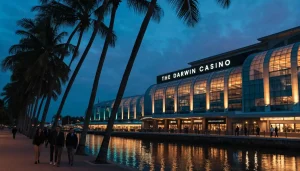
Darwin Casino: A Guide to Stays, Dining and Visits
The guide considers the venue as a workplace and gathering place, alongside stays, food, events...

Hobart Casino Guide: Poker, Hotels and Key Questions
An overview of Hobart casino questions, including live poker formats, accommodation and amenities that the...

Melbourne casino stays: details to verify
The page distinguishes casino-related search terms from confirmed facts about stays, gaming, dining, facilities and...

Perth Casino Guide: Hotels, Access and What to Verify
A practical look at accommodation, venue access and casino-related details, with clear limits where the...

Queensland casino details: what to verify
Hotel labels, nearby accommodation and venue amenities are separate claims that need confirmation before plans...

Best Casino in Sydney: What the Search Can Confirm
A practical look at what the Sydney casino search can establish about accommodation, gaming, dining,...

Casino Stays in Tasmania: Hotel Listings and Practical
A guide to interpreting casino accommodation, gaming, dining and amenity searches in Tasmania without treating...

Victoria Casino Guide to Hotels, Dining and Facilities
The article distinguishes established casino information from unanswered questions about hotels, dining, facilities, parking and...

Casino Hotels in Western Australia: Stay Guide
A practical guide to accommodation, dining, venue facilities and the booking details that shape a...

Fast payout online casinos in Australia: key checks
An overview of offshore casino access in Australia and the conditions that can shape withdrawals,...

Instant payout online casinos in Australia
Withdrawal speed depends on separate stages, from operator review and account checks to approval and...

Live Dealer Casinos Online in Australia: What to Know
This guide distinguishes Australia’s rules for offshore casino operators from what game pages, reviews and...

Live casino online in Australia: legal limits
It distinguishes the Australian rule on offshore real-money services from what the available evidence can...

Online Keno Casinos in Australia: Legal Limits
This guide distinguishes real-money online casino keno from venue play and explains why offshore access...

Best Pokies in Adelaide: Hours and Legal Limits
Opening hours vary by venue, while online and mobile pokies remain subject to Australia’s legal...

Pokies in Brisbane: Hours, Rules and Online Play
Venue opening hours, machine operation and online casino settings are separate questions when searching for...

Pokies in Canberra: venue hours and search limits
Opening times, gaming-room access, location claims and payment labels all require venue-specific context. Canberra Pokies:...

Geelong Pokies: Venue Hours, Rules and Local Limits
Venue schedules can separate gaming rooms from other services, while local rules and safeguards shape...

Pokies in Melbourne: What Can Be Verified
The article distinguishes available evidence from assumptions about airport access, venues, opening hours, machine returns...

Pokies in New South Wales: Hours and Access
A venue’s opening status is not proof that poker machines are available, and location-based searches...

Best Pokies in Perth: What Can Be Verified
A cautious guide to checking gaming-area availability, payout claims and location details without treating listings...

Best Pokies in South Australia: A Practical Guide
A guide to interpreting game and RTP claims, checking local venue details and distinguishing online...

Pokies in Sydney: Find a Venue and Check the Details
Location, venue-specific opening times and the limits of payout claims all matter when comparing pokies...

Best Pokies in Tasmania: Venues, Hours and Online Limits
Venue listings, gaming-room availability and online casino searches each have limits that matter when comparing...

Real-money online pokies in Australia: legal gap
Australia has no licensed online casinos, so payment options, offshore status and game terms do...

RTP Pokies in Australia: How to Compare Returns
RTP describes a configured return over time, but settings and casino listings can vary, making...

Big Red pokies online in Australia: legal status
The page distinguishes unverified Big Red game and download claims from the legal limits on...

Most Trusted Online Casinos in Australia: Legal Reality
Australia has no domestic online-casino licences, so trust claims must be weighed against legal limits...

Pokies Open Near Me in Australia: Casino Hours
Casino operating hours do not confirm that every room, counter, restaurant or other service is...

Pokies Parlour Casinos in Australia: What to Know
The term describes a place or gaming area, while authorisation attaches to the casino property...